
Gold Road strategic relationship
Mojave’s current development strategy is centered on converting the Gold Road non-binding LOI into definitive agreements, completing ore and permit compatibility work, and using Phase 0 to validate the operating assumptions that matter before larger-scale development decisions are made.
Strategic relationship framework
Mojave and Gold Road signed a non-binding Letter of Intent dated May 19, 2026. The LOI contemplates a strategic relationship involving toll processing of Telegraph Mine ore and a staged equity investment by Gold Road into Mojave, subject to due diligence, ore compatibility review, permit compatibility review, definitive agreements, required approvals, and board approvals by both parties.
- Contemplated processing: Phase 0 and initial Phase 2 Telegraph ore through Gold Road, subject to final agreements and compatibility review
- Contemplated investment: staged strategic investment by Gold Road, subject to definitive agreements, approvals, and closing conditions
- Current status: non-binding LOI; definitive agreements pending
- Strategic value: potential offsite processing path without immediate onsite mill construction
Near-term critical path
The immediate execution priority is not full-scale mining. It is to close the legal, technical, permitting, and operating gaps required to begin Phase 0 on a controlled basis.
1. Definitive agreements
- Negotiate and execute long-form Gold Road toll processing and investment agreements
- Finalize disclosure approval, confidentiality, operating, and settlement provisions
- Confirm funding mechanics, closing procedures, and related documentation
- Define responsibilities, timelines, deliverables, and decision rights
2. Compatibility review
- Complete ore compatibility and permit compatibility review
- Evaluate ore characterization, deleterious elements, handling, crushing, grinding, and metallurgical behavior
- Define ore acceptance criteria, rejection rights, delivery procedures, and storage requirements
- Finalize sampling, assaying, chain-of-custody, and settlement mechanics
3. Phase 0 readiness
- Advance reclamation planning, financial assurances, and County approvals
- Finalize access-road operating plan, biological/cultural clearances, and site controls
- Prepare contractor, equipment, crushing, loading, trucking, and assay workflows
- Establish operating KPIs before material extraction begins
Development strategy
Mojave Gold’s development plan is staged around operating proof. Phase 0 tests the practical mining and processing pathway. Phase 1 advances resource confidence. Phase 2 scales shallow mining only after Phase 0 results are understood.
Phase 0 • Pilot mining
- Target: approximately 2,100–2,200 tons of selectively mined high-grade material
- Objective: validate mined grade, dilution control, and ore handling
- Processing: contemplated offsite toll processing through Gold Road, subject to definitive agreements and compatibility review
- Permitting/readiness: reclamation plan, financial assurances, County approvals, and access/site controls
- Output: operating proof before larger Phase 2 development
Phase 1 • Confirmatory drilling
- Drilling program designed to validate and consolidate the historical dataset
- Support preparation of a compliant NI 43-101 mineral resource estimate
- Focus on the zones most relevant to near-term development sequencing
- Gate before larger Phase 2 development
- Improve resource confidence for strategic transactions, financing, or continued self-development
Phase 2 • Shallow scale-up
- Conceptual shallow open-pit mining to approximately 70 feet depth on patented ground
- Initial Phase 2 processing contemplated through Gold Road under the LOI framework, subject to final agreements
- Additional tonnage remains subject to mutual agreement and economic review
- Potential to evaluate alternative processing or future onsite processing where justified
- Scale-up decision should be based on Phase 0 operating evidence
Permitting strategy
- Vested mining rights posture eliminates the need for a new mining permit, subject to applicable legal and regulatory requirements
- Surface mining activities require an approved reclamation plan and financial assurances under SMARA
- Phase 0 is intended to be sized for a narrower administrative approval path focused on reclamation and bonding
- Biological, botanical, and archaeological clearances are expected to focus on previously disturbed historic mining ground
- Access is expected to use the historic mining road established prior to 1976, with RS-2477 right-of-way posture to be documented and coordinated

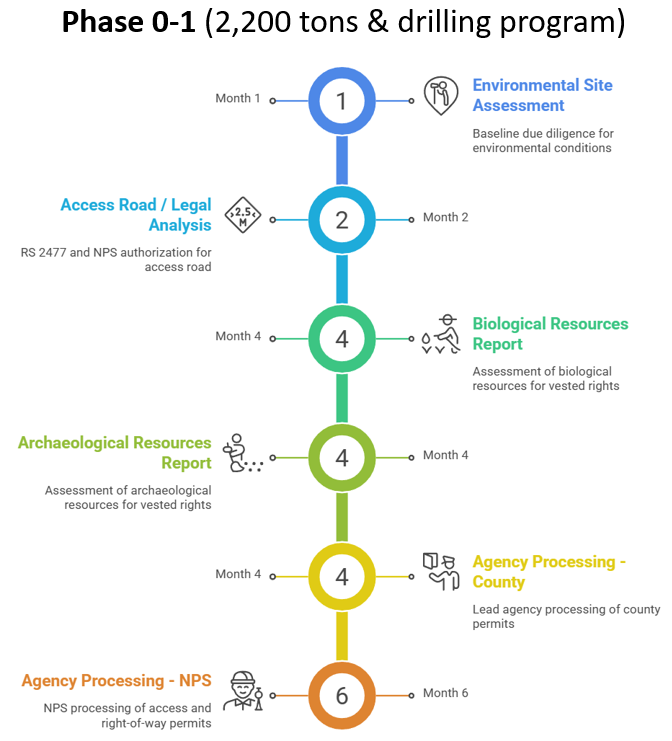
- Phase 0/1: reclamation plan, financial assurances, environmental/site clearances, and County processing
- Phase 2: larger operating footprint would require additional planning, studies, approvals, and operating controls
- Actual timing may vary based on agency review, technical studies, financial assurance requirements, and operating design
Processing & logistics
The current preferred processing path is the contemplated Gold Road toll processing arrangement. The purpose is to test Telegraph through offsite processing before Mojave commits to a larger processing strategy.
Gold Road pathway
The LOI contemplates that Gold Road would process Phase 0 and initial Phase 2 Telegraph ore, subject to Gold Road’s permit authority, plant specifications, operating constraints, ore compatibility requirements, legal review, technical review, and definitive documentation.
- Potentially avoids immediate onsite mill construction
- Allows Phase 0 to test real-world settlement and recovery mechanics
- Provides a defined processing diligence path
- May support faster operating proof if compatibility and approvals are confirmed
Key operating procedures
Definitive agreements are expected to address the procedures required to protect both Mojave and Gold Road during sampling, delivery, processing, and settlement.
- Ore acceptance criteria and rejection rights
- Sampling and assaying protocols
- Mutual assay review and dispute procedures
- Chain-of-custody procedures
- Delivery point, storage, and scheduling
- Settlement timing and payment mechanics
- Compliance with applicable permits and laws
Preserved optionality
Mojave should preserve reasonable optionality for additional Phase 2 tonnage, alternative processing arrangements, ore-sale fallback, or future onsite processing if economics and permitting justify it.
- Gold Road path for Phase 0 and initial Phase 2
- Alternative processors or ore-sale fallback if needed
- Future onsite processing only after operating evidence supports the development decision
- Additional Phase 2 tonnage subject to economic and strategic review
Value creation milestones
Telegraph’s value should increase as specific technical, legal, permitting, commercial, and operating risks are removed. The development plan is designed to create multiple rational decision points for continued self-development, partnership, financing, or strategic transaction.
| Milestone | Primary proof created | Principal risk reduced |
|---|---|---|
| Definitive Gold Road agreements | Commercial framework for processing and staged investment | Transaction execution risk |
| Ore and permit compatibility review | Processor acceptance path and permit fit | Processing / permit compatibility risk |
| Phase 0 permitted | Reclamation, financial assurance, and County approval path | California permitting execution risk |
| Phase 0 operating proof | Mined grade, dilution, trucking, processing, settlement, and cost evidence | Operating model risk |
| Phase 1 resource work | Historical data advanced toward compliant resource confidence | Resource confidence risk |
| Phase 2 scale-up decision | Higher-tonnage development decision based on operating evidence | Larger development-commitment risk |
| Expanded resource / PEA / PFS | Broader technical and economic validation | Financing and strategic transaction risk |